




Urban Pig
NR. 010
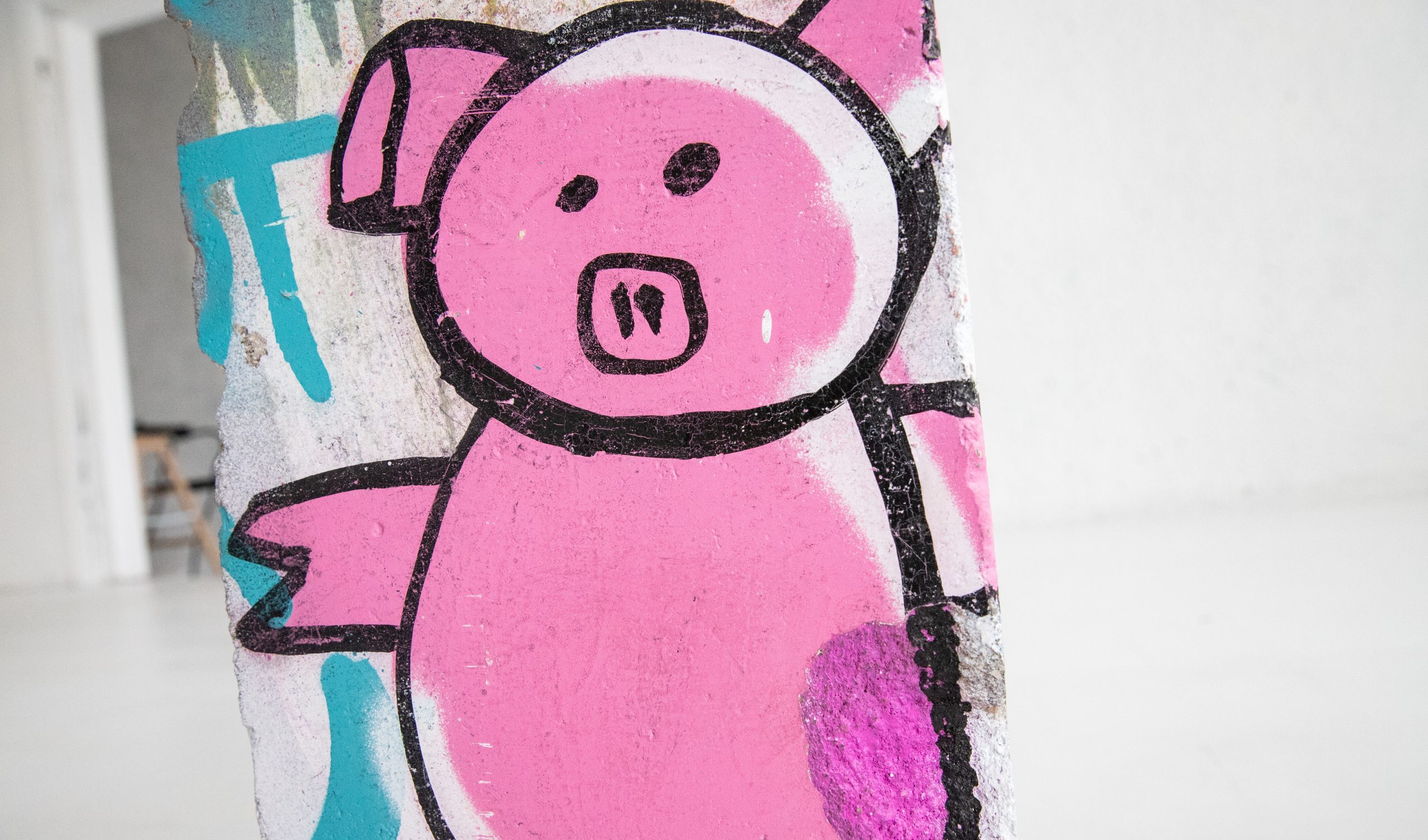
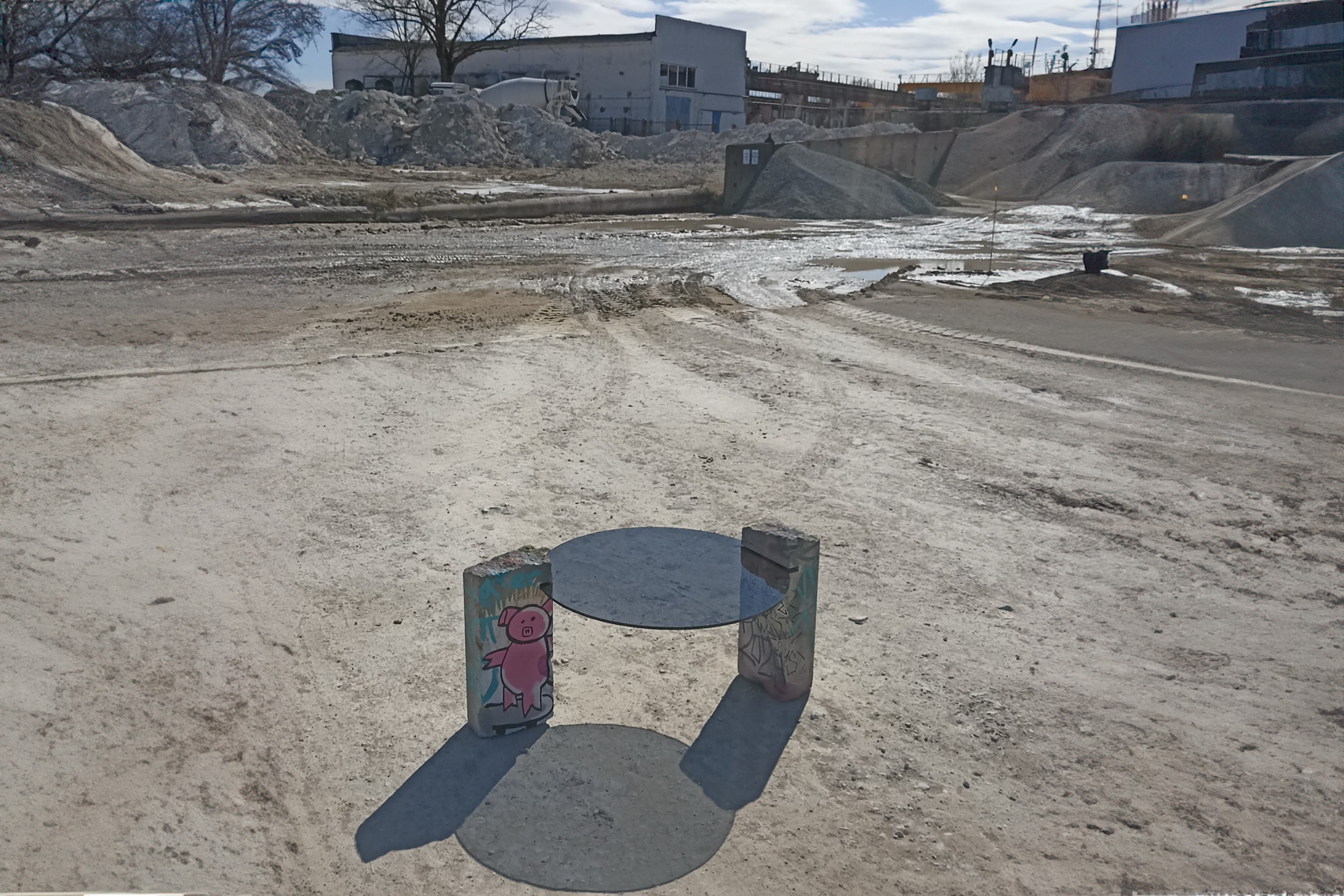
The table ‘Urban Pig’ was born from the remains of the city, concrete blocks left over from the construction process, which were given a new function and meaning. It is a brutal and at the same time playful interpretation of urban design, where sustainability, art and symbolism collide.
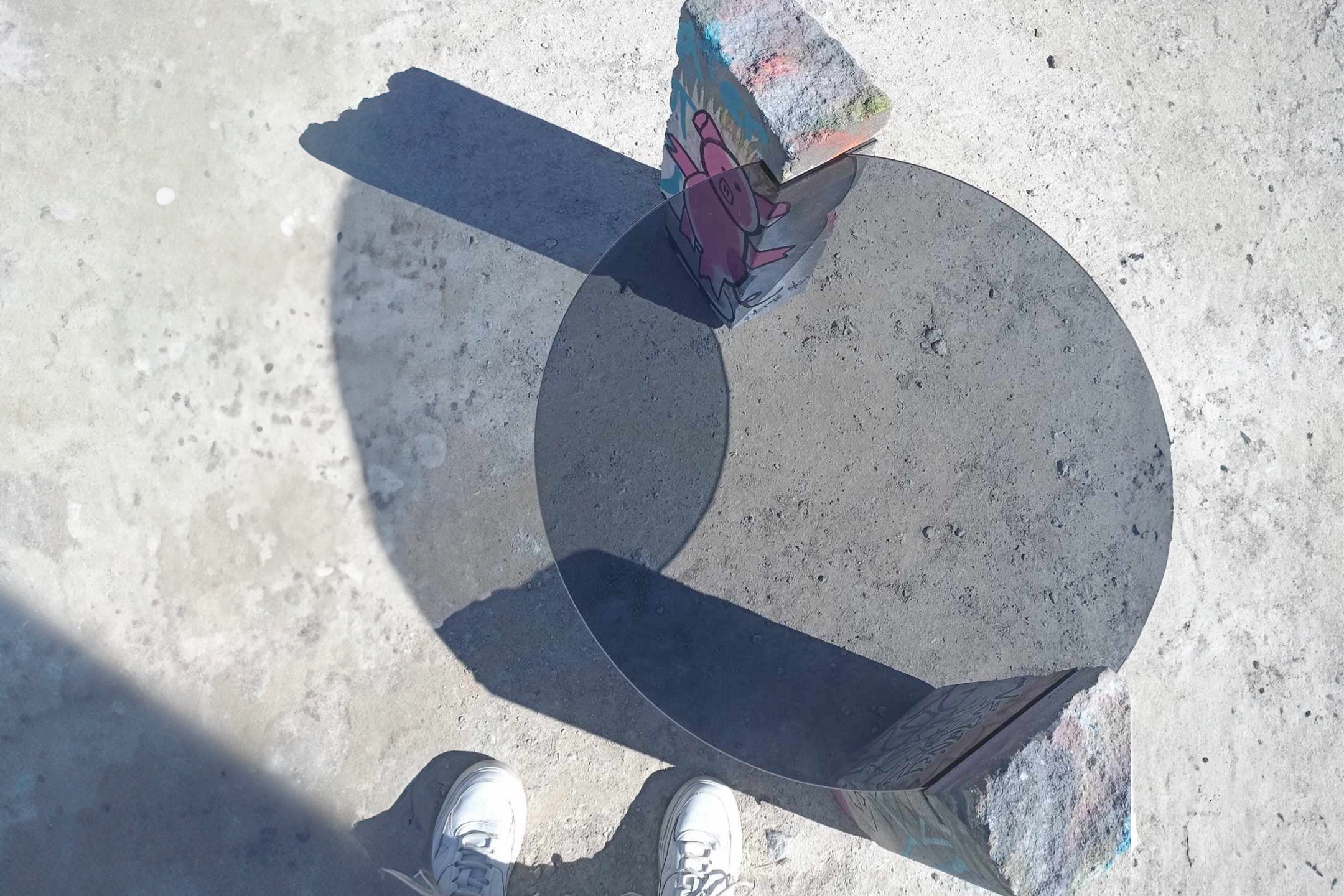
One of the concrete supports is decorated with a bright pink graffiti-style pig riding a skateboard – a symbol of freedom, rebellion and life. This is an allusion to the philosophy of veganism, where an animal is not an object of food, but an active actor with the right to exist. Next to it are spontaneous markings, urban textures, random layers of color and time. The circular surface of frosted glass easily floats above this massive base – like a contrast between transparency and chaos, between industrial waste and a new design object. Each block is unique, unrepeatable, with its own history and scars. It is not just a piece of furniture – it is a fragment of the city, becoming a story.
*Price varies based on size and artwork detail.
CONTACT ME






Beavis and Butt-head
NR. 002
Table “Beavis and Butt-head”
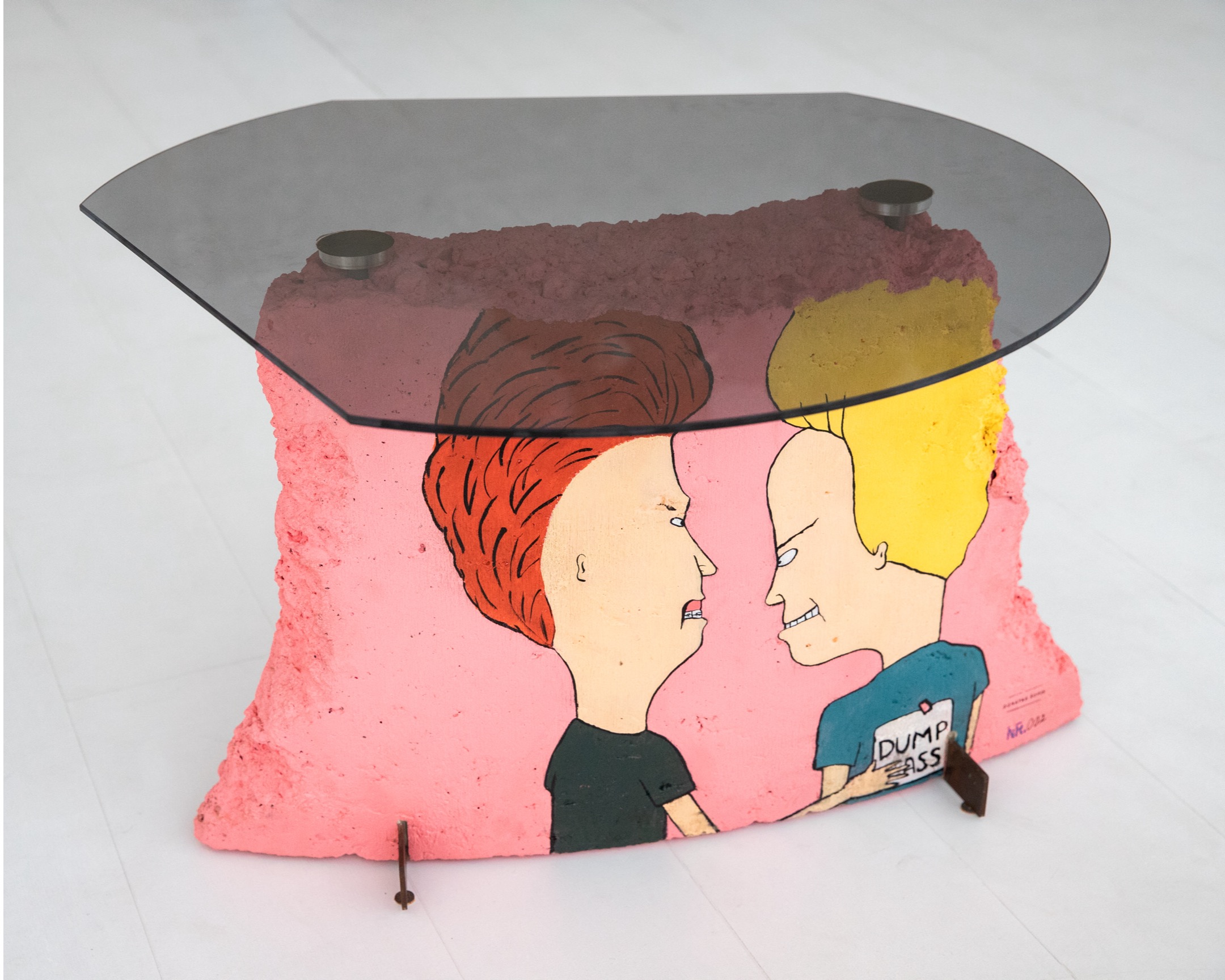
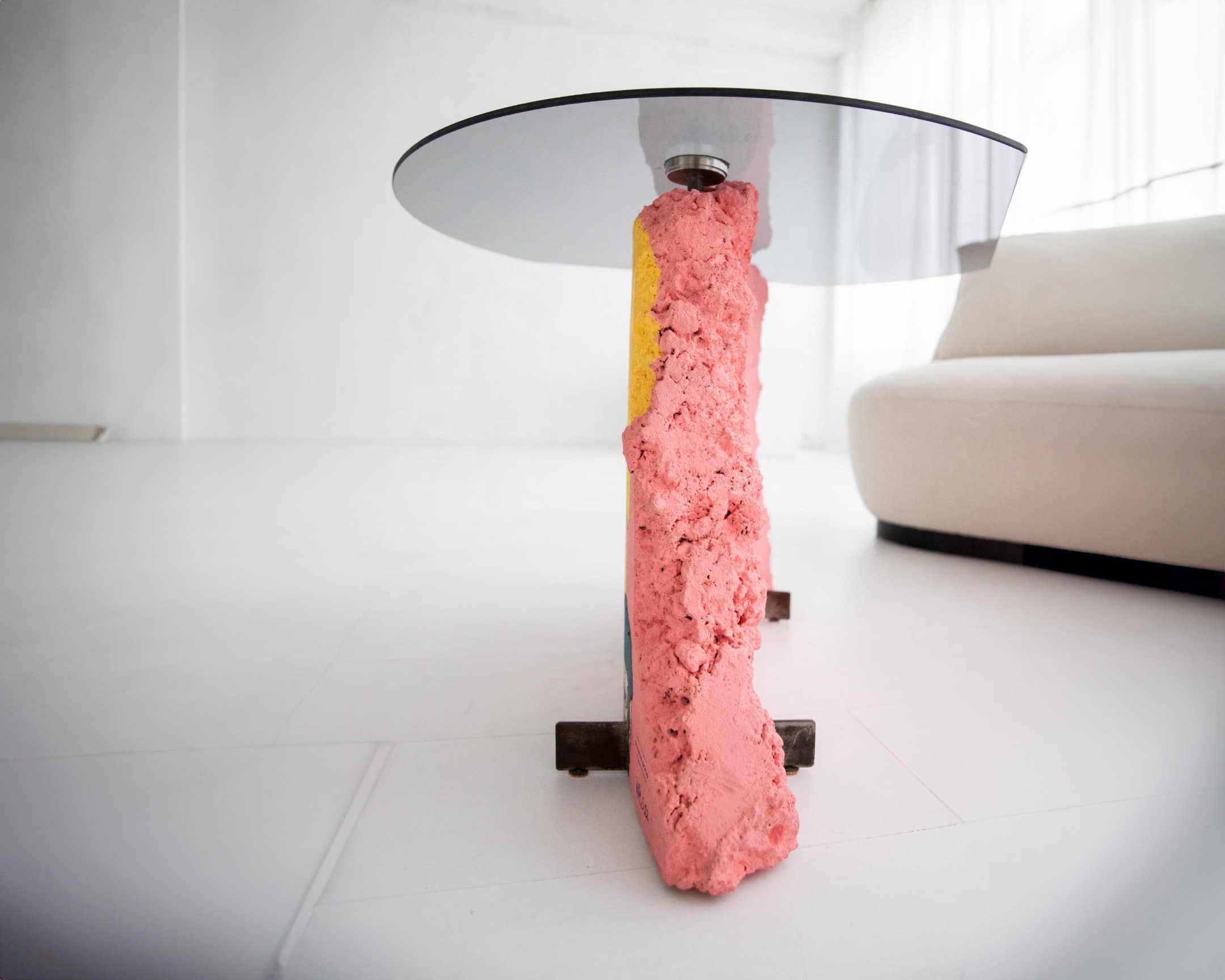
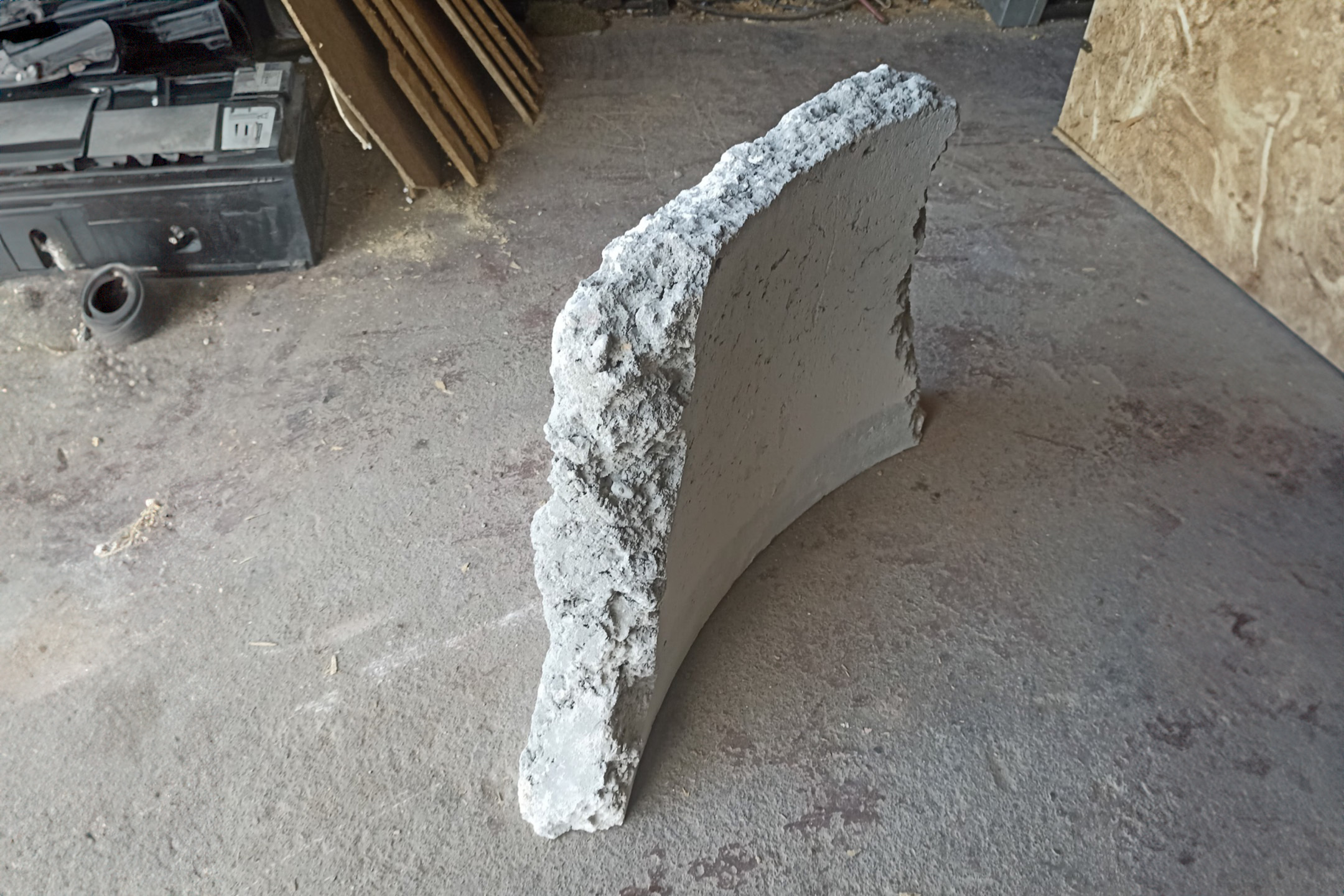
This is one of my first works – like a starting point for the entire collection. The object is created from a cracked, crumbling concrete well ring, which was discovered and brought to a new life.
Metal plates embedded in the concrete base not only give it additional stability, but also visually introduce a sense of industrial solidity. The surface of the tinted glass subtly repeats the roundness of the well, but the corners are deliberately cut asymmetrically. This brings a sense of surprise, of “orderly mess”, which allows the object to organically blend into any environment. The glass is easily removed, so the object remains not only sculptural, but also functional.
The pink color is like a visual candy: soft, warm, nostalgic. It contrasts with the severity of the concrete, giving it playfulness and visual lightness. Hand-drawn concrete characters Beavis and Butt-head – classic 1980s “crazy” characters – come here thanks to Dovilė Šopytė. Their faces not only create a clear aesthetic line, but also invite you to return to the days of adolescence, where everything was a little simpler and a lot louder.
This object combines what is “found” with what is consciously “created”. It is not just a piece of furniture – it is an emotional capsule that contains nostalgia, irony and layers of urban culture in one concrete piece.
*Price varies based on size and artwork detail.
CONTACT ME

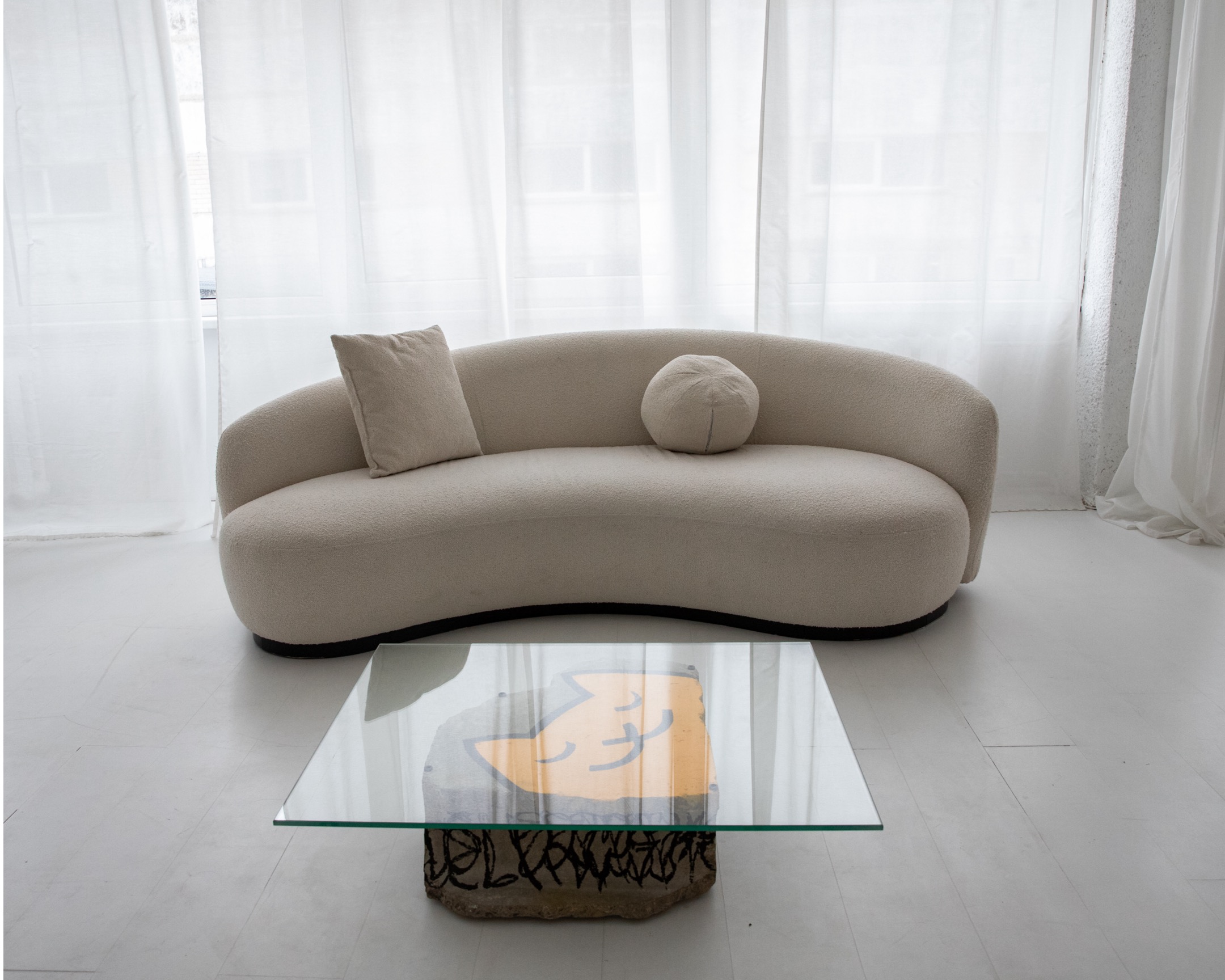


Cat
NR. 011
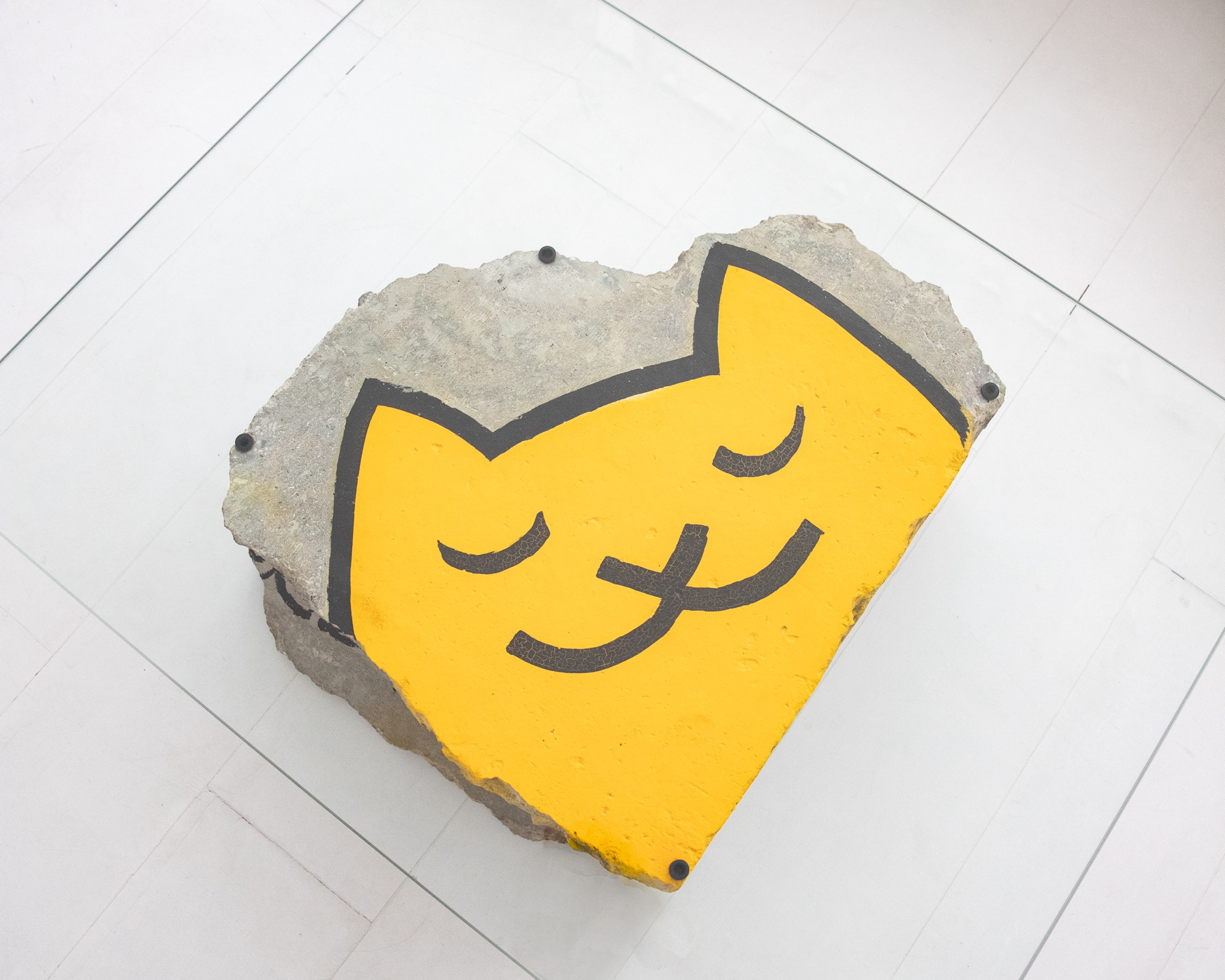
Perhaps the most famous Kaunas cat smiles on the table. It is found in many places in the city on walls and fences, gates, bromes, panels and curbs. The cat’s expression – sleepy, relaxed – conveys gentle irony and eloquent silence. Like Kaunas itself, this cat seems quiet at first glance, but hides creative energy. It symbolizes the freedom and unique spirit of the city, the identity of the underground artist community and peace in the chaos of everyday life.
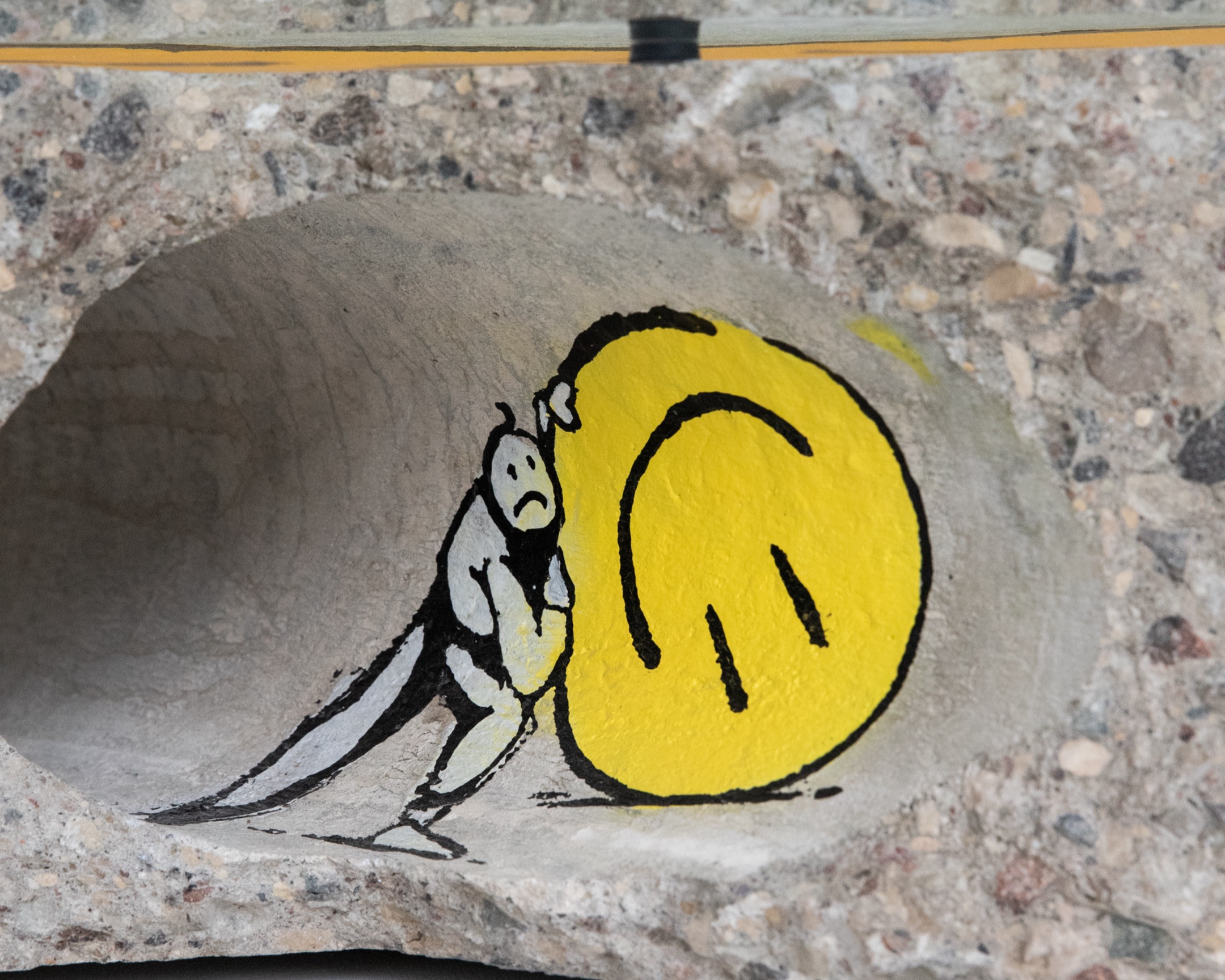
However, under this large and bright face of peace, there is a hole in the concrete block. It is like a cave in which the modern Sisyphus carries his burden (author of the work – Morphs).
A rough concrete block is the equivalent of the modern Sisyphus stone. Here the stone becomes a symbolic form of the burden of life, a metaphor for the creative process, efforts and perseverance, and at the same time – a uniquely human object on which the cat… rests.
This detail invites the viewer to interpret: perhaps our Sisyphus has already come to terms with his task? Or has he found peace even in meaninglessness?
*Price varies based on size and artwork detail.
CONTACT ME


Tunnel to myself
NR. 016
This is a unique object that combines raw urban architecture with a moment of personal reflection. The remaining concrete overlay and the restored mirror balance between the aesthetics of brutalism and a sensitive narrative. The used mirror – found, cracked, should have been thrown away. Its imperfection becomes a value, a meaningful transience, fragility and human imperfection. The concrete base retains authentic tunnel motifs – graffiti, symbols and drawings, familiar to those who have been through the city’s dungeons, through the backstage of life. The voices of the street come to life in the cavities – a crocodile, letters, lines that speak of the everyday noise of the city, spontaneous creativity and freedom. The mirror, like a person, is anchored in this massive background – fragile, but courageous. This mirror speaks of the connection between the outside and the inside. The tunnel into oneself is a moment of an adult city dweller – a mirror of introspection, experiences, traces of the past, and still-living inner freedom.
*Price varies based on size and artwork detail.
CONTACT ME


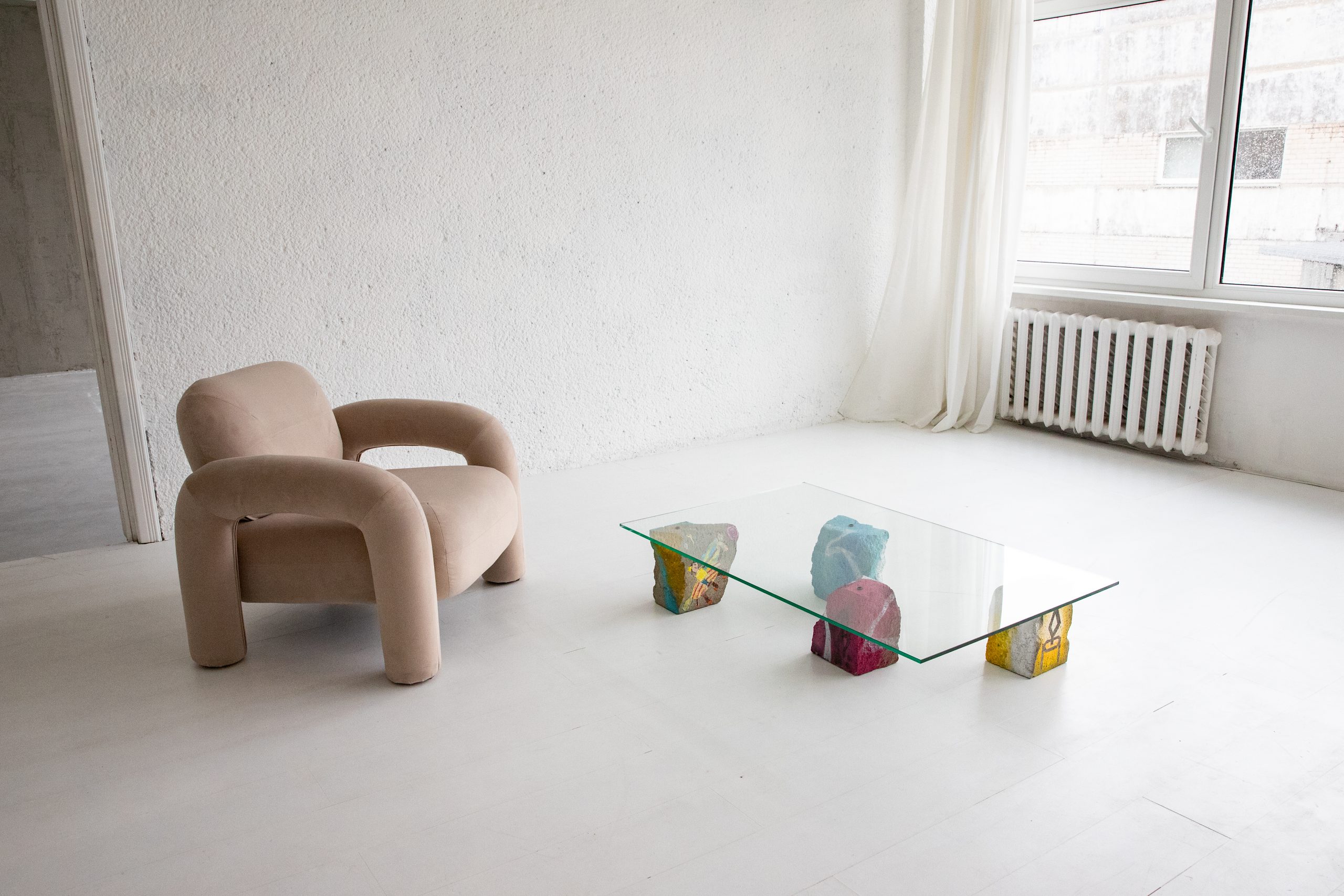
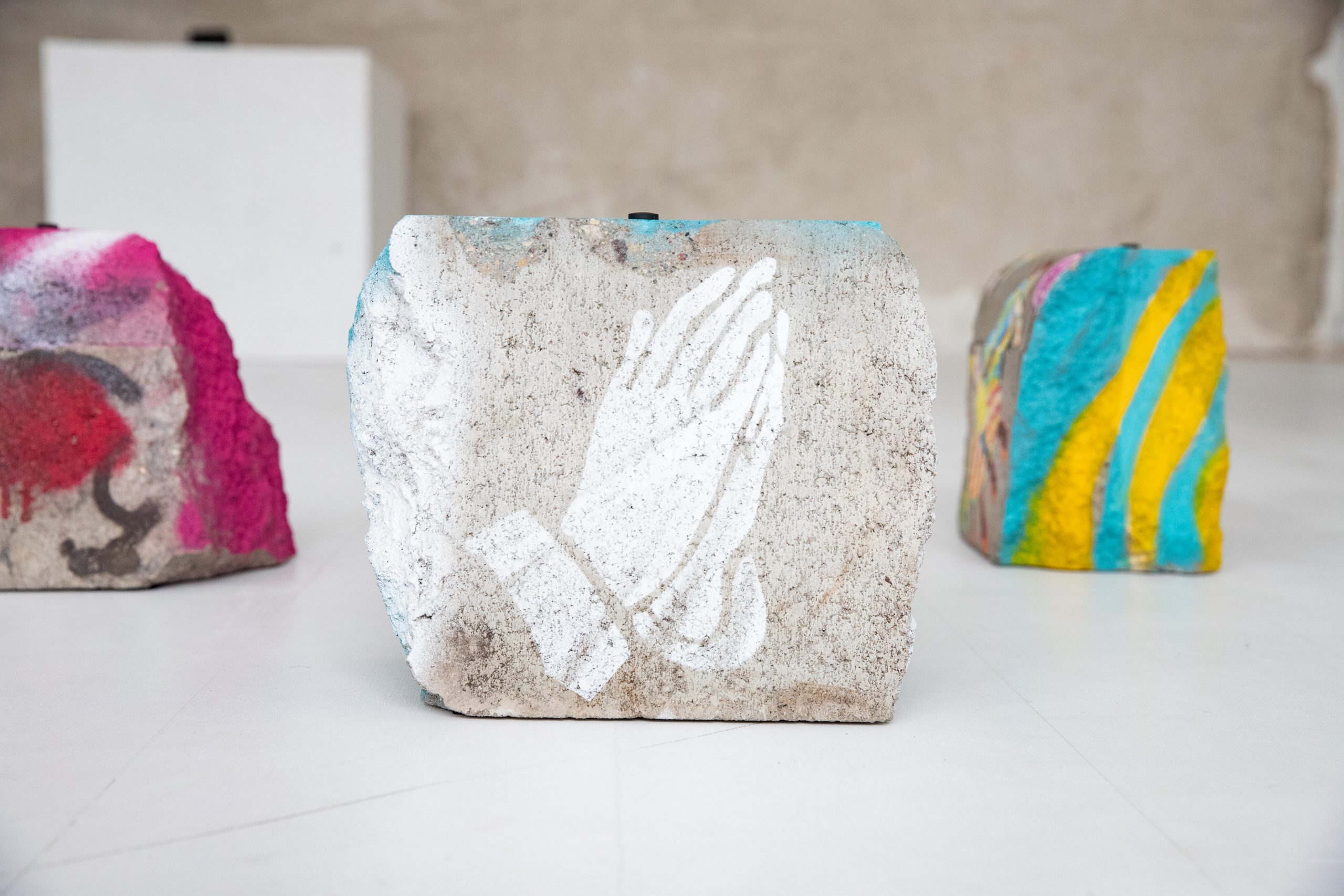

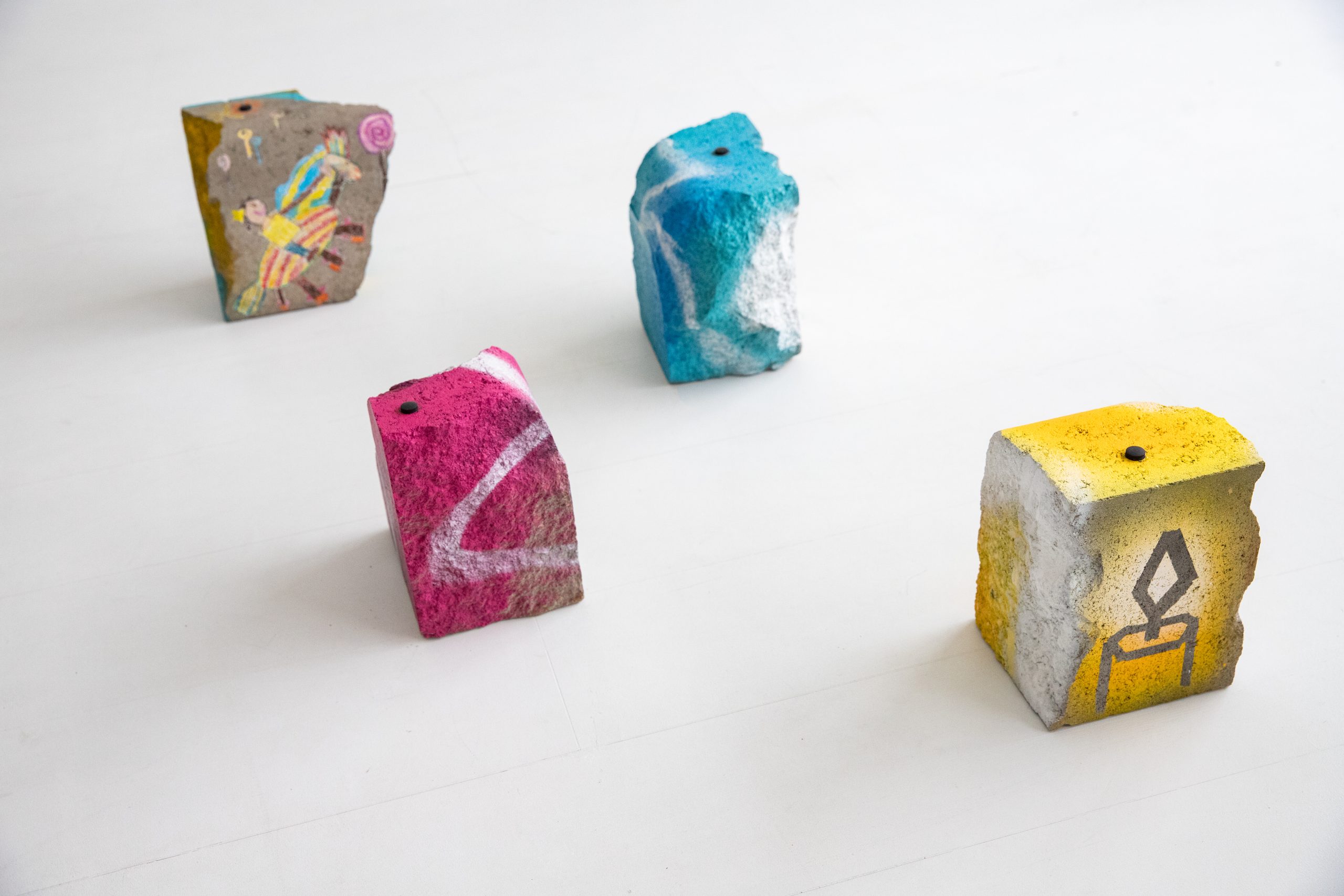




Blocks
NR. 007
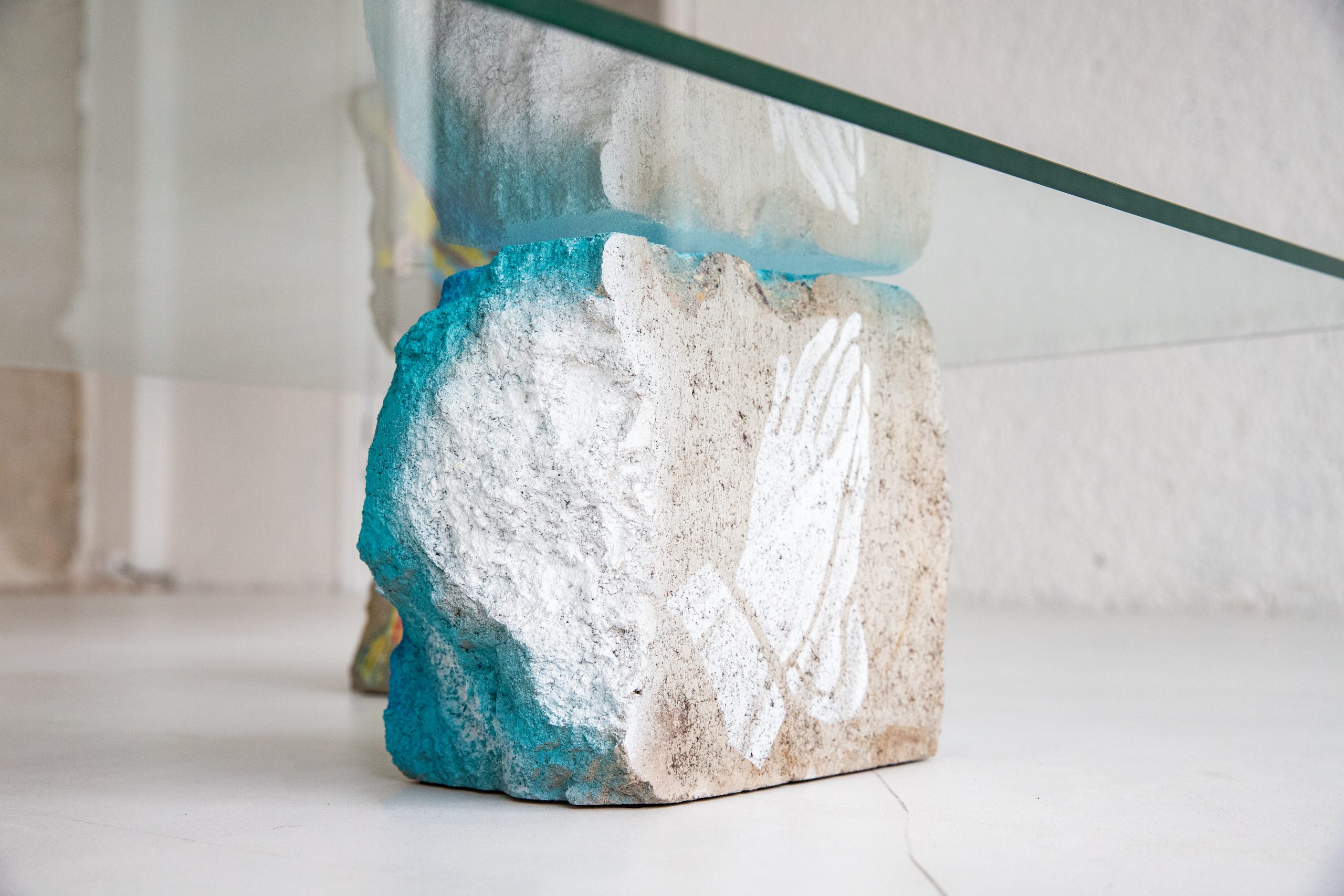
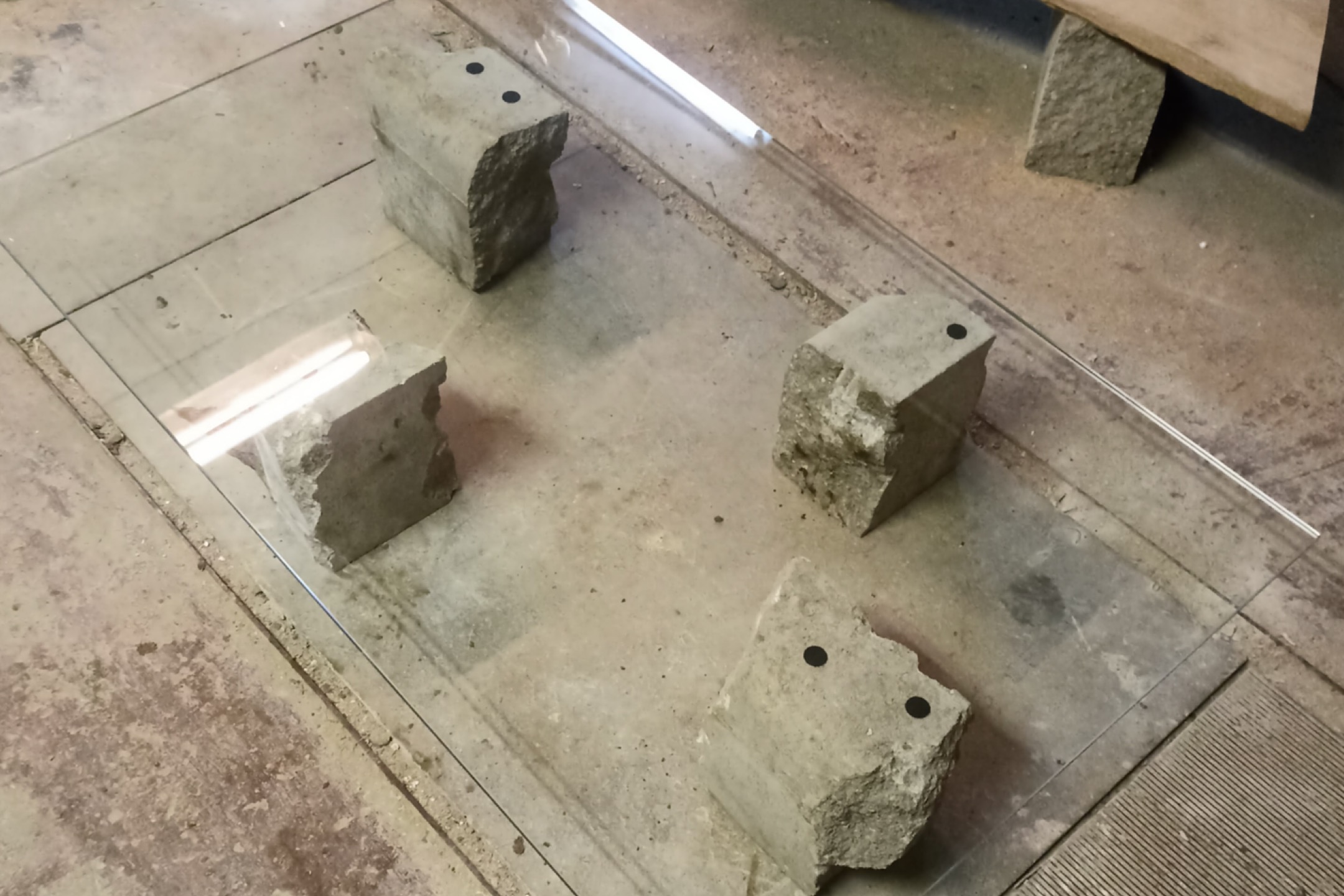
This installation playfully balances between chance and construction. Concrete blocks, as if randomly thrown on the floor, take on a new meaning as soon as a structuring sheet of glass is fixed above them. This glass connects the fragments into a whole, turning them no longer just waste or remnants, but the foundations of a table – like the foundations of a city, which are made up of what we often forget or do not notice.
Each block is a unique story. In one of them, a brightly colored drawing of a Kaunas city street opens up – a naive but lively, full of energy horse, like a childhood memory or a dream captured on the surface of concrete. In the other – stylized hands, symbolizing the presence, action, peace, and touch of people to the fabric of the city. It is a gesture that says: “We are here. We create.” A light that reminds us of constant faith, even where it is sometimes lacking…
The colors are bright, in the direct manner of street art. Pink, yellow, blue – they contrast with the roughness of the concrete, as if trying to revive it, soften it. And everything is crowned with glass – a transparent border between chaos and order, between play and function.
This is a work about a city that is formed not from large monuments, but from small fragments – imperfect, but real. And about how everyday life, art and urban culture can merge into one manifesto in the form of a table.
*Price varies based on size and artwork detail.
CONTACT ME
I decided to portray the graffiti culture of Kaunas’ streets, which has its own unique language and visual expression. I felt that it represents a certain kind of freedom—without styles, without fashion, without trends. It is chaos which, at the same time, has its own order. I visualized how a product would unfold in an interior where organic forms merge with strictness, and glass provides clarity and structure. Graffiti drawings are a bold expression that adds character and vitality. It is a manifesto of freedom that transcends established norms, styles, and constraints.
Such an approach breaks boundaries while simultaneously creating a new understanding of beauty. It invites the viewer to reflect: What does beauty mean to them? What shapes their perception of aesthetics? Is what is called the “perfect form” an objective standard, or just a dogma that has developed over time? Is beauty created by expensive materials, or by perspective, context, and idea? Are trends that come from external influences valuable and sustainable, or are they just temporary consumer impulses?


Raising such questions means expanding the limits of perception and understanding: Do I choose, or am I being chosen?
Concrete, as a material, is heavy, brutal, and strong, yet it has two sides. It embodies the principle of duality: day and night, good and evil, order and chaos. My goal was to utilize both the rigid and soft qualities of concrete and glass. Weight became a visual language, and its mass—a means of expression. A block that appears to be falling is stabilized by a plate or rod—a delicate balance between collapse and support. It is a metaphor for life, where the balance between stability and chaos is essential.
Glass… Does a small scratch, a chipped corner, or a detached fragment immediately turn it into waste? Or can these “imperfections” that break the idea of perfection open a new dimension of aesthetics? Could a defect become the starting point of a new design solution? By changing our perspective on raw materials, we can create new value—discover beauty in the unexpected and embrace it as part of uniqueness rather than a flaw.
Working with wood and concrete, I realized that true efficiency and beauty emerge when materials are allowed to speak for themselves. The most important thing is not to hide them or refine them according to artificial standards, but to reveal their true essence.
Not to change people according to one’s own vision, but to help them reveal and be themselves…

When creating, I see the bigger picture—it’s not just about the raw materials themselves but about the entire production chain. I saw how many unused resources surround us. Where one side has a surplus, another has a shortage. This is a huge potential that remains untapped due to established standards and habits. Storage costs become higher than disposal, but what if, instead of waste – exchange or recycling platforms were created? Where companies could trade excess raw materials at a reasonable price instead of simply destroying them?
This thought pushed me to take action. I went to a glass company in Kaunas to discuss about glass waste. A worker there openly said, “With the amount of leftover glass we have, you could build two huge houses, but no one needs it…” It felt like a sign.
Another situation confirmed this further. When we brought prepared glass for tempering, the manager informed us that a worker, assuming it was waste, had thrown everything into the glass container. It was a kind of disappointment, but at the same time, an understanding of how deeply ingrained the perception of “non-standard” materials as worthless is.

And finally, the drawing stage arrived. Graffiti artist Ramūnas agreed to bring my vision to life. We selected Kaunas’ graffiti styles and started working. The process was full of changes. What I had imagined did not always match reality, but that only opened up more possibilities. After the first graffiti-covered block, I started visualizing how it would look in a sterile, modern space. The contrast between urban chaos and a minimalist environment created new meaning, life, and a distinct aesthetic.
I realized that it’s not enough to just create a product—you have to think about the context. Where will it be? How will it reveal itself? As the saying goes, “A piece in a garage might look like trash, but in an art gallery, it becomes a masterpiece.”
This is how not only products but also new perspectives on what is valuable are born.
VERANDA ID

Donatas Šopis – in his work, he reveals organic, natural forms and gives materials the opportunity to create their own narratives. The author’s work process reflects his approach: not to produce, but to use what already exists. Also, when exploring forms, he aims to create a model of harmony, where man and nature harmoniously interact. The creator’s approach combines science, art and philosophy, creating objects that are not only aesthetically attractive, but also encourage people to think and engage in important topics, such as sustainability.


Wood product creator Donatas: finally, I am working without any inner resistance
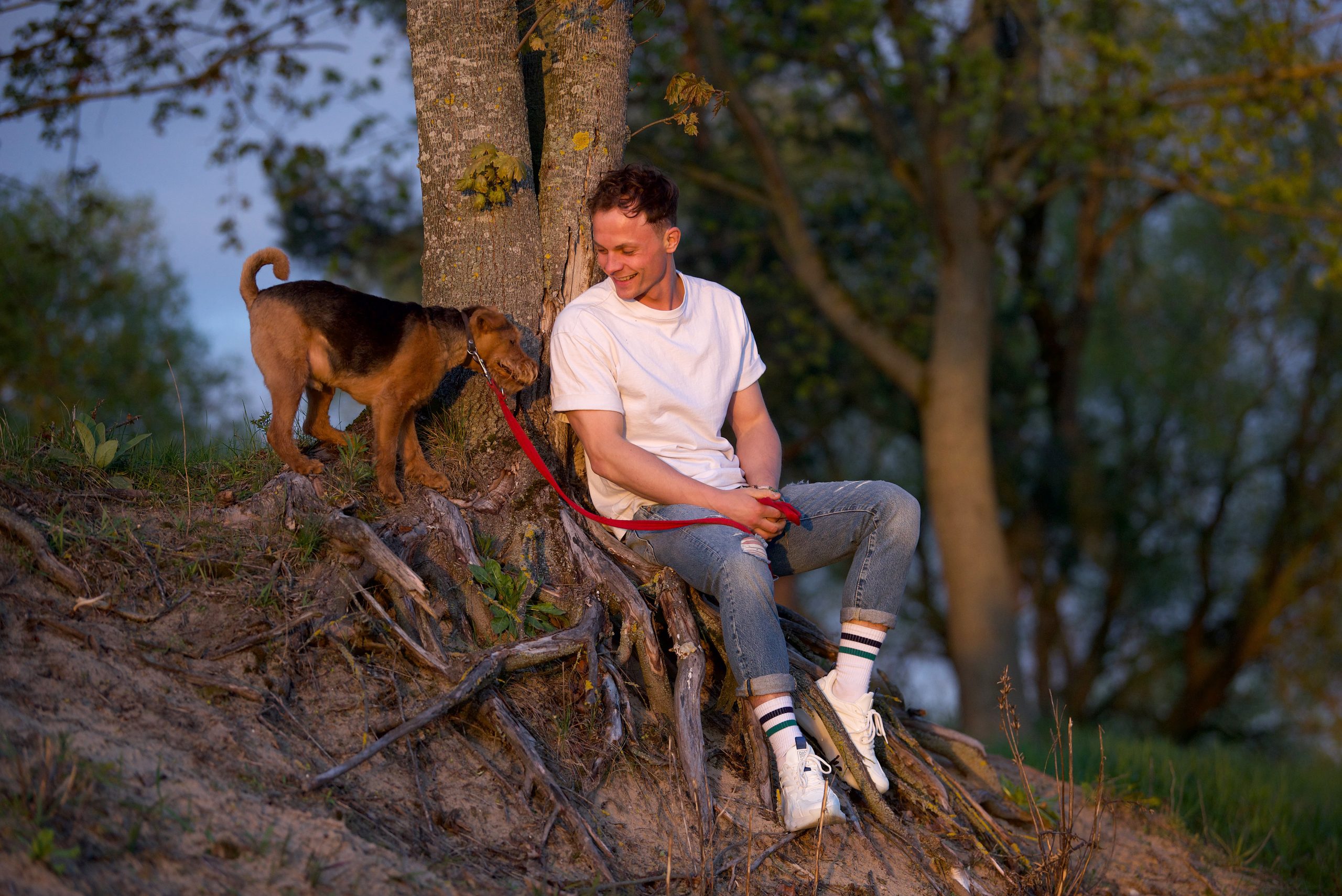
The importance of nature in the life of young Kaunas resident Donatas Šopis, and his self-awareness as part of it, has gradually integrated into his work. Currently, he creates furniture and interior accents, using fallen trees from emergency felling, as well as glass and concrete waste. Donatas says that organic natural forms are particularly revealed in contrasts, and having them in the home or workspace even helps people be more themselves.
– How did you start creating your products, which use minimally processed wood parts? How did you come to this particular creative expression?
– I am not an expert in furniture or interior design, nor have I studied it anywhere, but I have always liked to combine things that seem incompatible. For example, I don’t know how to precisely smooth or mill wood, but I’ve found people who are great at doing that, and I connect with them.
About six years ago, I participated in a competition in Kaunas, where we had to design a restaurant interior. I created my first tables, using pieces of tree trunks. Although I didn’t win the competition, I really liked the products and their idea.
Later, my friend, who owned a wellness center in Spain, invited me to join her in the activities of a healthier food restaurant. While working there, I met someone who had an exhibition at a gallery. I offered them my handmade furniture and interior accents, which soon ended up on display. So, these products came about organically. I never had a rational goal to engage in their production, nor did I study the market or find a niche I wanted to occupy. Everything grew out of a feeling.

Why exactly these products? Like myself, my works are constantly changing. However, they always contain nature and authenticity. In my work, I really enjoy combining nature’s organic forms with stricter, “neater” forms and materials like glass and concrete, revealing beauty through contrast. I think my work is a visual reflection of who I am. When you truly understand and recognize what is authentic to you and are not afraid to accept it, there is no tension. And when there is no tension, the results you want emerge.
– Sustainability and ecology are important topics for you, and this is directly visible in your works. How did these things become important to you? Where do you get materials for your works?
– Sustainability and ecology are almost a consequence of everything I do. I have always been a nature person. I remember as a child, my grandparents, sister, cousin, and I would go to the forests of Dzūkija, where we would spend three months in tents during the summer. Perhaps from there comes the understanding that we are part of nature and must respect it.
In Kaunas, I have connected with a few arborists and companies that deal with removing fallen trees. We keep in touch. I go to special yards where cut trees are piled up and pick the pieces that will otherwise be used for biomass fuel. I’ve noticed that it’s much easier for big companies to operate out of inertia – cut, transport, and grind trees – rather than think about what else could be done with these materials, whether it’s wood, concrete, or glass. At first, many people found it strange that I wanted to take these scraps for myself, but now it no longer surprises anyone.
Recently, I brought concrete waste to my workshop, which I will use for a new series of works. And while taking my dog to the groomer, I saw some stacked tiles ready for removal. After asking, I took them. My colleague, who came to the workshop, was surprised that I kept picking up what he considered junk, as these items seemed worthless. People often think that if things are scattered or thrown away, they are worthless, but if they’re expensive, they must be valuable. But that’s not the case.
– You say that your current activity came to you very organically, based on a feeling. Have you always made decisions about what you want to do in life so easily?
– Definitely not. There was a time when I tried to meet societal norms. But during that time, I felt a lot of inner conflict, as if I were running away from myself.
Since my father worked in the automotive maintenance sector, I tried to realize myself in that field. It brought me financial benefits, but I strongly felt it was not my path. When I told my father that I wanted to pursue making interior accents and furniture, he didn’t approve of it and argued that this activity wouldn’t provide enough financial return. This actually motivated me even more to continue what I was doing and prove that it could become a source of livelihood.

Over time, I’ve realized that it’s very important to understand the context in which you end up – whether it inspires you or diminishes you. I clearly felt this when I visited a neuroaesthetic exhibition last year organized by the “Amres Art” gallery. Afterward, I felt encouraged and uplifted. I realized that when a person’s thoughts, words, and actions align, they can experience their full energy and potential, which elevates anything they do to a completely different level.
– I imagine your home contains many of the things you’ve created. How do these pieces affect you?
– In my home, about 80% of the items are my creations. Every time I come home, I feel like I’m in my cozy, warm fortress where I can completely relax and be myself.
I think it’s because, when creating my works, I am in a state of complete flow, with no resistance.
– What conditions do you need to avoid feeling resistance and to be able to immerse yourself in the flow state?
– Movement and sports are very important to me: I run in the forest, swim in the river. It relaxes my mind, strengthens my body, and I feel how I become more sensitive to my surroundings and to myself.
Reflection
“Reflection” is an exhibition of a work of art that invites the viewer on a deep inner journey. It is embodied in the desire to reveal people’s confrontation with their own fear of expressing themselves, of conforming to imposed norms and of being afraid to open up to their true selves.

The central symbol of this exposition is a wooden coffee table, with organic shapes, which symbolizes a part of nature and man’s creative contribution. This coffee table is a collaborative work, a product of nature and man. It reflects the beauty of everyday objects that are often overlooked. Holes, cracks and otherwise “damaged” wood shapes add uniqueness and warmth to the image.
“Reflection” is embodied in the belief that openness is courage and sensitivity equals conductivity. This exhibition invites people to see what they don’t normally see, to reveal their authenticity and not to be afraid of showing their uniqueness. It is an invitation to look at yourself, at your feelings and who you are beyond the imposed norms and stereotypes.
“Reflection” is an art that not only invites the viewer to perceive beauty on an aesthetic level, but also on an inner level, which cultivates the self and helps to reveal the real you.
Article: https://www.dizainovacija.lt/en/1_dizaino_objektas/reflection/

Donatas Šopis: inspiration from nature, intuition and sustainable creation

In today’s fast-paced world, where technology and mass production seem to dictate everything, there are reminders to slow down and reconnect with nature. One such visionary is Donatas Šopis, an artist whose deepest passion is to create through intuition, sensitivity, and the exploration of living systems. His art is not only a reflection of the perfection of nature, but also an invitation to bring that harmony closer to our everyday lives.
For Donatus, the world is a model of balance, in which humans and nature coexist in a subtle but profound dance. His work, inspired by the organic forms of nature, seeks to reveal the beauty of life itself, to awaken an understanding of the importance of nature in our lives and its crucial role in the environment. With his works, he invites us to see not only aesthetics, but also to be interested in sustainability topics, and encourages us to reflect on our impact on the environment and the need for a conscious life.


Revealing naturalness
Donato’s work is distinguished by its authenticity. He does not hide the “flaws” or “imperfections” of the materials he uses. Instead, he highlights them, allowing the natural beauty of these so-called “defects” to unfold. These raw elements bring us closer to our own understanding. Cracks, irregularities – these are not mistakes, but uniqueness and truth, which we often try to cover up both in our lives and in the things that surround us.

This approach challenges societal norms of perfection and overconsumption. By revealing “hidden” beauty, Donatas speaks to a deeper, subconscious longing for authenticity in a world where we often hide behind masks. He believes that much of modern consumption – whether it’s objects, relationships or addictive substances – stems from a repressed desire for truth. His work seeks to break down the cultural codes that imprison us, coming face to face with our own authenticity.
Sustainability is the basis of a lifestyle
For Donatas, sustainability is not just about eco-friendly practices or recycling materials – it is a fundamental shift in perception. True sustainability starts with self-understanding, recognizing the root causes of our behavior, and seeking solutions. This deeper understanding leads to more thoughtful choices in how we live and create.
“I am a creator who works with materials that are usually considered used, discarded, or no longer needed. My creative philosophy is to maintain the natural and organic forms of these raw materials, without changing their essence, but highlighting their natural beauty,” says D. Šopis.


The author collects wood from waste sites, and the creation itself is born from what he has at the time. This seemingly limited choice of materials forces him to look for solutions and new angles of approach, and provides an opportunity to unleash his creative potential. “Through my work, I want to emphasize that what may seem “unnecessary” or “inappropriate” in our perception can actually be perfectly applied in the context of creation. Each raw material I use is of local origin, which helps maintain a connection with local nature and culture. I believe that through visual creation, it is possible to influence not only the attitude towards the environment, but also towards oneself,” says the author.
Rethink and Connect
Donatas Šopis’ work is much more than aesthetic creations; it is a philosophical journey into the heart of nature and our relationship with it. His creative process is a constant dialogue with the materials he uses, allowing him to create works that resonate with authenticity, beauty and meaning. By exploiting the imperfections and rawness of nature, Donatas reminds us to reconnect with our true selves and the environment around us:

“We are valuable just as we are, and we have all the tools and opportunities to create what we desire. Nature itself dictates the design of my works – natural forms guide the creative process, but it is this process that opens up new design possibilities and variations that are not initially noticeable.”
In times of increasing distance and consumerism, his works invite us to pause, reflect, and engage with deeper truths about ourselves and the world, inspiring a shift in perception and returning to a balanced, harmonious existence where art, nature, and humanity create in unity.


“For this reason, I chose not to work on a commission basis. It is important to me to encourage people to search for and discover their unexpressed potential – it is like putting on “new glasses” and looking at the world with different eyes. This approach is also close to the circularity and “closed loop” models, where value is created from what already exists and what can be applied again in a new context,” thinks D. Šopis.
Article link: https://zurnalaslizdas.lt/donatas-sopis-ikvepimas-is-gamtos-intuicija-ir-tvari-kuryba/